


From Trigger to Transformation: Turning Tension into Leadership Capacity
Most growth does not begin with inspiration. It begins with triggers.
A difficult conversation you didn’t handle well.
A leadership moment that felt heavier than expected.
A conflict that keeps repeating itself.
An emotional reaction that surprised you.
In these situations, it's common to respond by seeking more knowledge - another framework, another tool, another model. And knowledge matters. But information alone rarely changes how you behave.
What changes us is how we make meaning from experience. Transformation begins when this experience meets reflection.
The disorienting dilemma
The theory of transformative learning, introduced by adult learning theorist Jack Mezirow, suggests that meaningful development often begins with what he called a “disorienting dilemma” - an experience that challenges how we see ourselves and the world.
Not a comfortable insight. But a disruptive experience.
According to Mezirow:
Transformation occurs when we critically examine our assumptions, question familiar interpretations, and experiment with new perspectives.
In practice, this means growth does not begin when we acquire new knowledge – reading a book, listening to a podcast or sitting in a classroom. It begins when something in our current operating model no longer works.
The tension of not knowing what to do next.
The misalignment between intention and impact.
The moment when confidence feels forced – the question of fake it until you make it.
However, these are not setbacks. They are invitations.
Experiential Learning: The Mechanism of Change
For most of our lives, we have been used to the idea that learning takes place in classrooms, with teachers telling us what we need to know, and that the ability to answer questions related to that knowledge is measured, providing us with feedback and evaluation. This could work to some extent, but in real-life situations, things are more complicated, and answers are rarely straightforward.
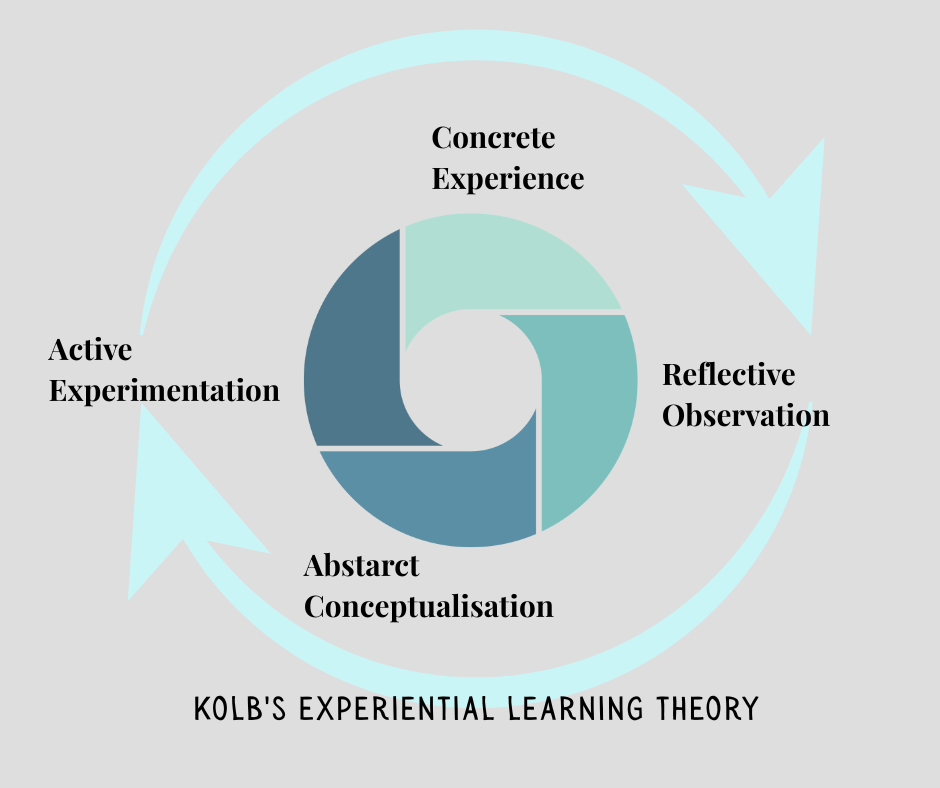
While Mezirow explains why transformation begins, social psychologist David Kolb`s Experiential Learning Theory (ELT) explains how it unfolds through his experiential learning cycle:
1. Concrete Experience
2. Reflective Observation
3. Abstract Conceptualisation
4. Active Experimentation
Kolb’s model shows that learning is cyclical and behavioural. This explains a common phenomenon in professional development: Many people attend various trainings. Few change their behaviour. Why? Because the full cycle is rarely completed. Transformation requires returning to real situations and trying something different.
Without reflection, experience becomes repetition. Without experimentation, reflection becomes philosophy.
Knowledge can provide a solid foundation and confidence, but especially when it comes to leadership, personal development, or coaching, traditional knowledge-based responses have their limitations.
From concept to context
Research on situated learning by Jean Lave and Etienne Wenger adds another critical dimension: learning is embedded in social and relational contexts. We do not develop leadership skills in isolation. We develop them in participation - in teams, in communities, in real interactions. Skills such as trust-building, navigating conflict, and influence cannot be mastered through abstraction.
We learn through involvement in real contexts, including meetings, negotiations, difficult conversations, collaborative projects, and more.
Contemporary organisational psychology reinforces this approach. Studies on emotional and social competence in leadership (e.g., Boyatzis, 2008; Cherniss, 2010) consistently show that effectiveness depends less on technical mastery and more on how leaders regulate themselves, interpret social cues, and respond under pressure.
In other words: Presence is not a soft skill. It is a performance variable.
Designed to Reveal
Some unconventional learning environments accelerate this process by making patterns visible.
For instance, in horse-assisted leadership experiences, feedback is immediate and embodied. Horses respond not to declared intention, but to internal coherence. When presence is fragmented, the response shifts. When alignment is clear, cooperation follows. Research in equine-facilitated learning (e.g., Aranda et al., 2023) indicates increased self-awareness and interpersonal effectiveness through this kind of experiential feedback. Similarly, art-triggered reflection invites leaders into ambiguity.
Arts-based development research (Taylor & Ladkin, 2009; Adler, 2011) suggests that engaging with art enhances perspective-taking, cognitive flexibility, and reflective capacity. When leaders engage with abstract visual material, it interrupts habitual analytical patterns. This creates space for new interpretations, often revealing hidden assumptions.
Again, the pattern repeats: Experience → Reflection → New meaning → Adapted action.
The method may vary. The learning cycle remains.
Each step is essential in order to unlock potential, and this is where transformative learning programmes can play a vital role in personal and professional development. With the right trigger and support from experienced coaches who can facilitate the process by creating psychological safety and asking the right questions at the right time without judgment, this could lead to genuine change. Change beyond the surface level. Change that can have a ripple effect.
Building Skills That Matter
Leadership does not unfold in theory. It unfolds in complexity. In challenging environments. In emotionally charged conversations. In moments when certainty is not available. In those moments, knowledge helps, but the capacity to navigate situations will decide the outcome.
When leaders embrace transformative learning, something shifts. Conflict becomes information. Feedback becomes calibration. Ambiguity becomes space for perspective. And over time, repetition of reflection and experimentation turns experience into crucial skills.
The skill to pause before reacting.
The skill to stay present under pressure.
The skill to align intention with impact.
The skill to turn control into connection.
Friction will not disappear. Complexity will not disappear.
But when experience is consciously integrated, pressure stops being something to manage and becomes something that strengthens capability. This is where leadership matures.
Over time, this process reshapes not only behaviour but identity. Not through the accumulation of answers, but through disciplined reflection in real situations.
And that is where leadership stops being a role you perform and becomes a capability you build.